
I named what I built Last Hour Experience. Read the name as a plain fact and it still holds: everyone gets one, without exception. So what would you do if you knew which hour it was?
A taste test in Michigan
In 2012, Ed O’Brien and Phoebe Ellsworth, two psychologists at the University of Michigan, published a taste test with 52 students. Each student tasted five Hershey’s Kisses, the small foil-wrapped American chocolates, in five flavors: milk, dark, crème, caramel and almond. The experimenter took them out of a bag one at a time, in random order. After each one, the student rated it from 0 to 10.
Half of the students heard the same words before every chocolate: here is the next one. The other half heard those words too, up to the fifth. Before that one, the experimenter told them it was the last.
That one word was the only difference.
What happened when the students heard the word last?
They liked the fifth chocolate more. Of the students who heard last, 64 percent picked that fifth chocolate as their favorite of the five. Of the students who heard next, 22 percent did, about the one in five you would expect by chance. The students who heard last also enjoyed the tasting as a whole more.
Why would that change how a chocolate tastes?
Ed O’Brien told NPR, the American public radio network, that people who know something is about to end are motivated to make the most of it. The fifth chocolate came out of the same bag as the other four. The only new thing was what the experimenter said before it.
Nobody announces it
Most of the last times in a life go by without anyone saying the word. At some point you carry a child up to bed for the last time, because the next night they climb the stairs on their own. A friend comes over one more evening before moving across the country, and you spend part of it answering messages. Both were last times. Nobody said so then.
Can you ever know which time is the last?
Sometimes. The last day at a job, the last night in a house before you move: those you see coming. Most ordinary moments you only recognize later, if at all. What you can do is say the word yourself, the way the experimenter did before the fifth chocolate, and see what it changes.
An apple tree in 1944
There is a famous answer to the question of what you would do if the world ended tomorrow: I would still plant my apple tree today. It is usually attributed to Martin Luther, the German monk whose protest in the 1500s split the Western church and gave rise to the Protestant churches.
Martin Schloemann, a German theology professor who studied Luther, went looking for where the line came from. In his 1994 book about it, the oldest written trace he found is a typed letter dated October 5, 1944, almost four hundred years after Luther died.
Karl Lotz, a pastor in the German town of Hersfeld, sent that letter to trusted members of the Confessing Church, the Protestants who refused to let the Nazi regime run their church. It was the sixth year of the Second World War. The letter dealt with church business: who would hold which post, and how the church would be run in the years ahead. He ended it like this:
“Please don’t let my letter trouble you, given the tense situation of our people. We will probably have to go by the Luther saying: ‘And if the world were to end tomorrow, then let us plant our little apple tree today.’”
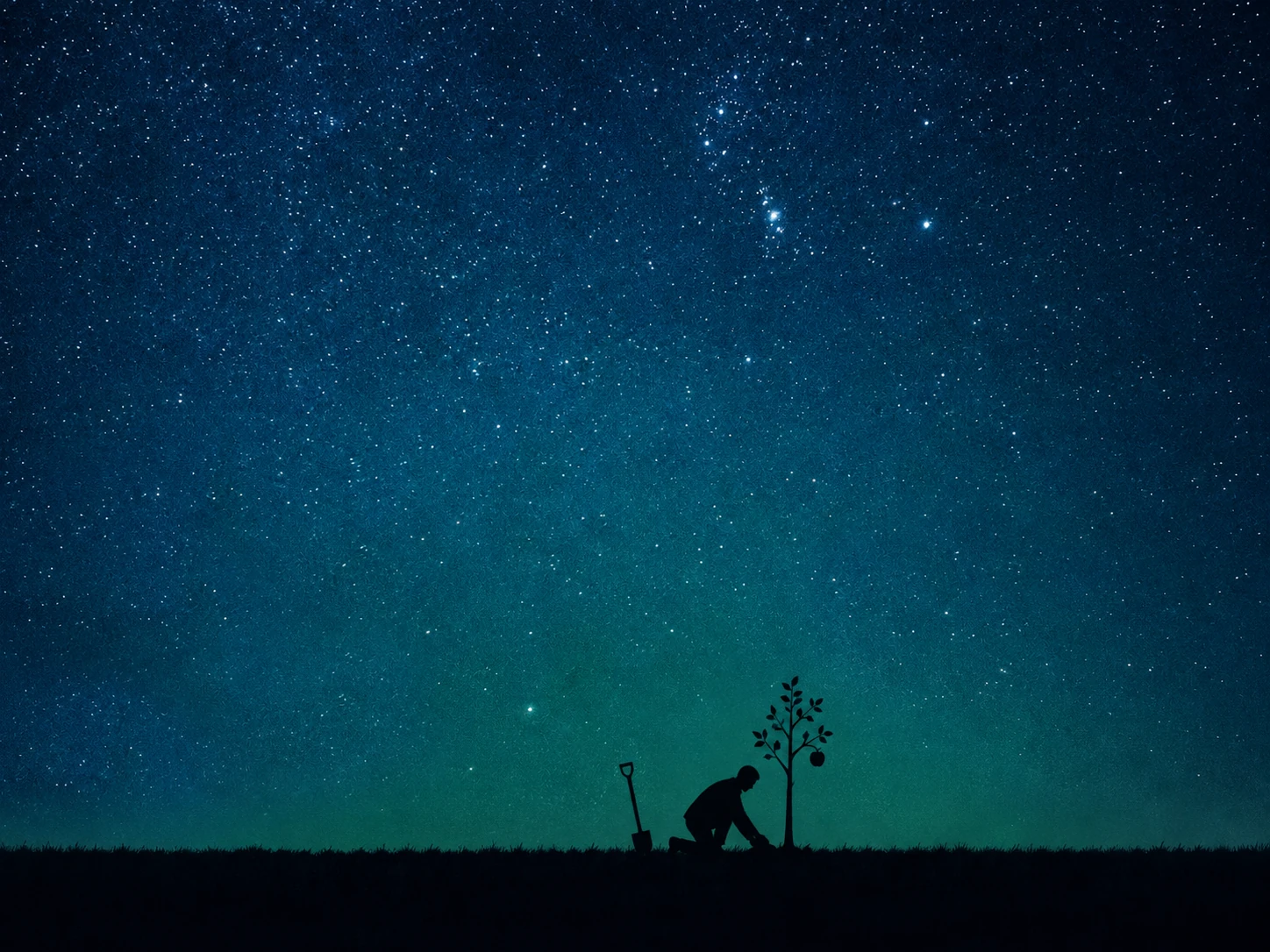
Did Martin Luther really say he would plant an apple tree?
So far, no one has found the line anywhere before 1944. Schloemann writes that printed versions only appear after the war. In a survey he ran in 1976, most people, older ones included, said they first heard it after 1945, often after 1950. He leaves room for an older source turning up someday.
What does an apple tree have to do with a last hour?
Lotz used the line to close a letter full of ordinary work, written in the middle of a war. So I read his answer like this: you keep doing what is in front of you, and you do it on purpose. Planting a tree is that kind of work. You do it with both hands, in the ground, today.
Say the word yourself
The taste test points to something small you can try. Pick one ordinary thing you will do today: the first coffee, the walk from the car to your front door, the last page you read before you sleep. Before you start, tell yourself: this is the last one. Then do it, and nothing else at the same time.
The fifth chocolate was only the last of five, in a short taste test. The word was enough.

What if saying “this is the last one” feels silly?
Then let it feel silly, and say it once anyway, before one cup of coffee. Afterward, notice what you did with the next few minutes. The students heard the word only once too, before one chocolate, from the person holding the bag.
The hour I built
I built Last Hour Experience as a single hour you spend alone, with headphones, as if it were your last. You hear the word in its name before you even begin, the way the students heard it before the fifth chocolate. You know which hour it is. What’s left is to be there for it.
Questions people ask. One of them is me.
Was the fifth chocolate simply the best flavor?
No. The flavors came out of the bag in random order, so the fifth chocolate was not the same flavor for every student. What the students in the last group had in common was the word they heard before it.
Is one taste test with 52 students enough to go on?
It is one small experiment, with students from one American university and five chocolates. It shows what one word did in that room. Whether the same thing happens with a meal, a visit or a whole evening, the study doesn’t say. I read it as a clear little picture, nothing bigger.
Does the last-chocolate effect work if you say the word to yourself?
That wasn’t tested. The students heard the word from the experimenter and had no reason to doubt it. Telling yourself the same thing about a moment that isn’t really the last is a different situation. I would still try it, because it costs one sentence and a few minutes.
Who was Karl Lotz?
Karl Lotz lived from 1890 to 1946 and was a Protestant pastor in Hersfeld, in central Germany. He had been an officer in the First World War, and from 1943 he chaired the council that led the Confessing Church in his region.
Sources
Saving the Last for Best, the 2012 chocolate study by Ed O’Brien and Phoebe Ellsworth of the University of Michigan, published in Psychological Science, a research journal for psychology. The link goes to its entry in PubMed, the research catalog of the U.S. National Library of Medicine.
What kind of chocolate is best? The last you taste, the announcement of the study by the Association for Psychological Science, the American society that publishes Psychological Science, as posted on the news site ScienceDaily. The 52 students, the five flavors and the 64 and 22 percent come from here.
Why The Best Chocolate Is The One You Eat Last, a 2012 NPR report by Allison Aubrey, with Ed O’Brien’s own explanation of the result.
Luthers Apfelbäumchen? (German for “Luther’s little apple tree?”), the 1994 book in German by Martin Schloemann, a German theology professor. You can read it online in the digital collections of the Bavarian State Library. The 1944 letter is on page 28, and the English of its closing lines in this article is a translation from his German.