Ask how much time you have left, and the question lands differently. Often you look away from it within a breath.
Twelve, then one again
This is an old logo variant by Angelo, from 2021, made at my request. I wanted a clock version of the company logo, because it is all about time.
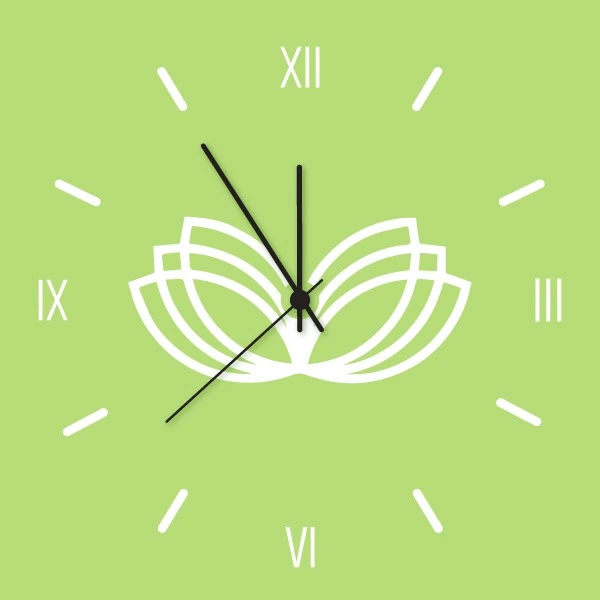
A green face, white Roman numerals, two black hands. In the middle, where the hands are attached, sits a lotus. Since 2021 the lotus has been the symbol of my brand, a sign of waking up.
On a clock like that you see where you are in the day. After twelve comes one again. Tomorrow the hands go around the same circle. Nothing on that face ever runs out.
The time you have left goes one way only. You cannot read the amount off any face.
Why is the time of day easy to look at when the time I have left is not?
Because the time of day comes back. Half past ten returns tomorrow, so checking it costs you nothing. The time you have left only shrinks, and its end has no place on any dial. Looking at it means looking at something that will not repeat. That is the moment you get anxious.
What the mind does first
In 1999, three American psychologists, Tom Pyszczynski, Jeff Greenberg and Sheldon Solomon, described what they think happens the moment your own death is on your mind. They published it in Psychological Review, an American journal for theories about how the mind works.
Their answer is two quick moves. You push the thought out of your head. Or you push death far into the future, by telling yourself you are healthy and the end is a long way off.

I see a glance at the clock as a form of that second move. The clock shows a time that comes back tomorrow, so your own end seems far away again.
Where does that jolt of anxiety come from?
In their model, the jolt comes just before the push. For a moment, the thought of your time left has your full attention, and then you move it out of sight. The anxiety you notice is the part of that turn you can feel. It remains a model, and the evidence for it is mixed.
Coffee or coffin
What did the people in the first experiment actually do?
In 1994, Greenberg and his colleagues published experiments with American university students. The students got two questions on paper. “Please briefly describe the emotions that the thought of your own death arouses in you.” And: “Jot down, as specifically as you can, what you think will happen to you physically as you die and once you are physically dead.”
A second group answered the same two questions about watching television.
In another experiment from the same paper, people then filled in half-finished words. Psychologists use words like these to see whether death is still on someone’s mind. COFF_ _ can become coffee. It can also become coffin.
Those who got the words immediately after the death questions came up with no more death words than the television group. Those who were first given something else to do came up with more. Once their attention had been elsewhere for a while, they wrote coffin more often. That fits the idea from 1999: right after the questions, people push the thought of death away, and once they stop pushing, it comes back up.
Did the coffee-or-coffin result hold up?
Only partly. In 2012, the American psychologist David Trafimow and a colleague ran the same comparison again, words right away or after a pause, and found the opposite of what the 1994 paper predicted. A 2015 analysis that combined earlier experiments found partial support for the pause effect.
The best-known experiment from that 1994 paper fared worse.
In it, after the two questions, students read two short essays about America, supposedly written by foreign students, one positive and one critical. Then they rated the writers. The death group rated the positive writer far more favorably than the television group did. The researchers saw this as a sign that people who have just thought about their own death hold on tighter to the views of their own country. In 2016 and 2017, seventeen research teams in the United States repeated that experiment with 1,550 people, some of the teams with advice from the original researchers. The difference was gone.
So the two quick moves are a cautious reading, based on shaky evidence. Nobody has measured what happens in your own head.
One minute, one question
If looking away is the first reflex, you can also look on purpose, briefly and with a clear end. This exercise has not been tested in any study. It uses the time of day as a handrail.
How do I look at my time left without getting swept up in the anxiety?
Find a clock with a second hand, or the stopwatch on your phone. Watch one full minute go around. Then say out loud, or write down: I don’t know how many of these minutes I have left. Let the jolt come and go. Stop after that one minute. You don’t need more.
What do I do with the anxiety once the minute is over?
Ask yourself one question: what do I want to have done before the hands reach this time tomorrow? Write down the first answer, and keep it small enough for one day. Call your sister. Finish the letter. Go to bed earlier. Tomorrow at this time, check whether you did it.

An hour with a fixed end
I built Last Hour Experience after a seminar in South Korea where I wrote my own farewell letter. You spend about an hour alone, at home, with headphones on, living through your own final hour. On a clock you never see how much time you have left. In that hour, the amount is set, and there is no time of day to glance at instead. Near the end you write a farewell letter, to whoever you choose. What would you want to have done before your real last hour?
Questions people ask. One of them is me.
Why does a countdown feel worse than an ordinary clock?
An ordinary clock shows where you are in a day that comes back. A countdown shows only an amount that shrinks. That is the view the 1999 theory says people push out of sight. If a countdown app leaves you restless, that fits, though nobody has tested such apps.
Did the coffee-or-coffin experiment hold up in later research?
Only partly. A direct test in 2012 found the opposite of the pause effect, and a 2015 analysis of earlier experiments found partial support. The best-known experiment from the same 1994 paper vanished when seventeen American research teams repeated it with 1,550 people.
How often should I think about how much time I have left?
No study gives a number for that. The one-minute exercise in this article is short on purpose: one round of the second hand, one sentence, one small thing for the next day. I would start with once a week and see what it does to your days.
What if I lie awake at night thinking about my time left?
Then do the exercise in daylight, with something to do right after. If those thoughts keep you awake for weeks, or get in the way of your days, talk to your doctor about it.
Sources
The 1999 theory of the two quick moves, by Tom Pyszczynski, Jeff Greenberg and Sheldon Solomon, in Psychological Review, an American journal that publishes theories about how the mind works. The abstract is free to read, the full article is behind a paywall.
The 1994 experiments with the two questions and the half-finished words, by Jeff Greenberg and colleagues, in the Journal of Personality and Social Psychology, a research journal about how people think and behave. The abstract is free to read.
The 2012 test that found the opposite, by David Trafimow of New Mexico State University and psychologist Jamie Hughes, in Social Psychological and Personality Science, a research journal that publishes short articles.
The 2015 analysis that combined earlier experiments, by psychologists Christopher Steinman and John Updegraff of Kent State University in Ohio, in Personality and Social Psychology Bulletin, a research journal.
The report of the seventeen teams that repeated the 1994 experiment, by psychologist Richard Klein and many colleagues, published in 2022 in Collabra: Psychology, a journal you can read for free. It quotes the two questions word for word.
The Brand, the page on this site about how the lotus became my symbol in 2021.