
Less than four minutes later, a doctor with glasses leans over your deathbed. Nobody in the song mentions God, heaven or a soul. So can thinking about your own death be a spiritual experience when none of that comes up?
A song about firsts and lasts
The song is called Een dokter met een bril, Dutch for A Doctor With Glasses. Jan Boerstoel, a Dutch poet who writes song lyrics for the theater, wrote the words. Karin Bloemen, a Dutch singer and stage performer, recorded it in 2002 with the pianist Cor Bakker.
In the verses, Boerstoel runs through your firsts. First bath, first word, first steps while the whole room claps, first bike, first kiss, first house. Halfway through, he turns it around: from here on, the last times start to win.
Your last cigarette. You sell your surfboard, and your tango shoes too. Your last day at work, your last big trip. You walk through the rooms once more before you leave your last house. Then your very last hour strikes.
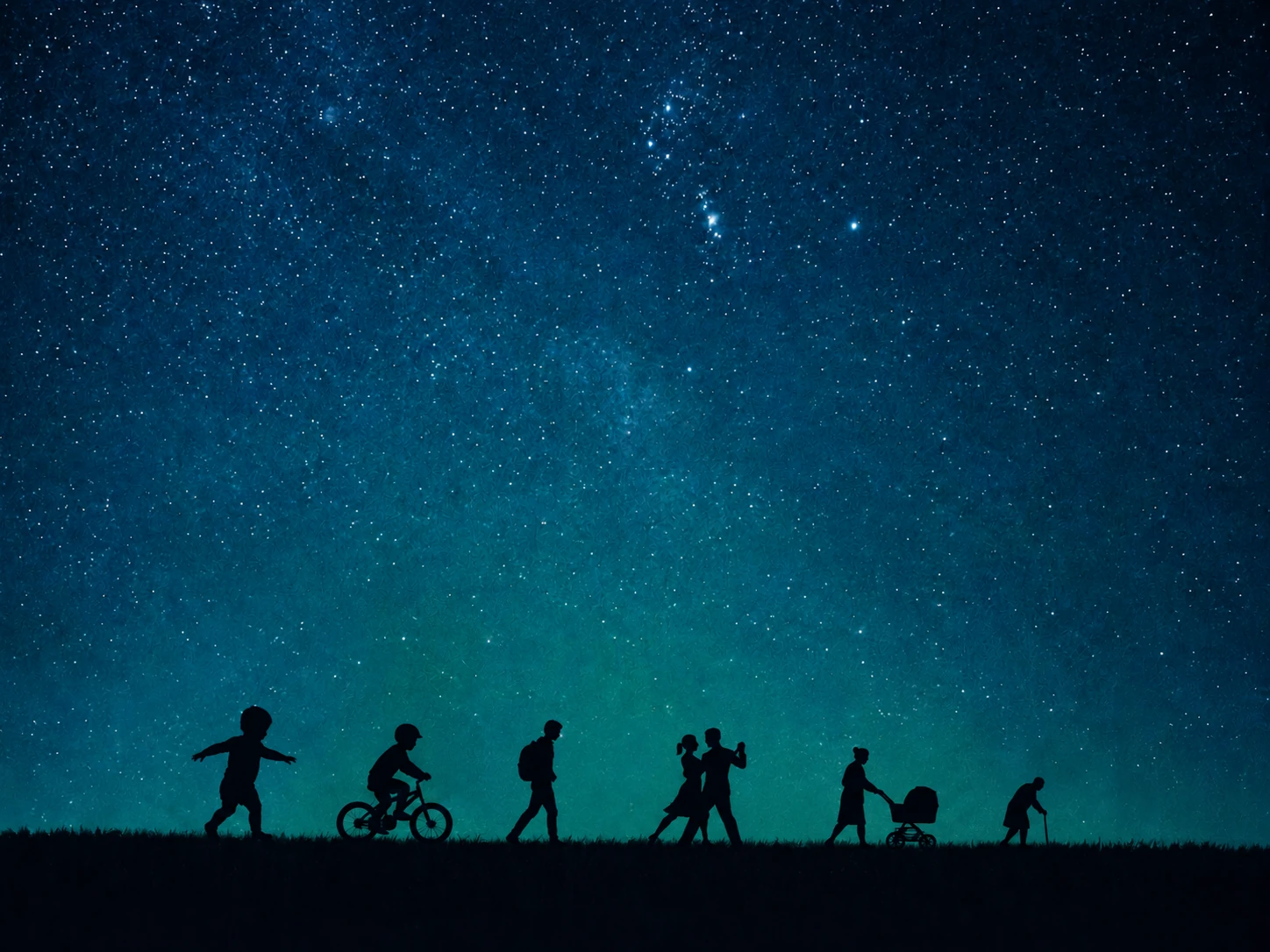
In the closing line, Boerstoel turns it around one more time. With your last breath, there is still something you get to do for the first time.
When I wrote my answer to the question "How spiritual is this experience?" in my FAQ, this song was in the first version.
Where the word spiritual comes from
What does spiritual actually mean?
The word comes from the Latin spiritus, which means breath. It goes back to spirare, to breathe. Long before it had anything to do with souls or churches, the spiritual part of you was the air going in and out. In that oldest sense, the song ends on the most spiritual moment of a life.
Do you need to believe in anything for it to count?
No. In my FAQ I put it this way: "You can make this experience as spiritual or religious as you want. And if that is not your language, it can still move you deeply." What happens after death I leave entirely to you. Kierkegaard did the same, at a grave, in 1845.
A talk at a graveside, written in 1845
Søren Kierkegaard was a Danish philosopher and Christian writer who lived in Copenhagen from 1813 to 1855. In 1845 he published Three Discourses on Imagined Occasions: three talks for a confession, a wedding and a funeral, written for occasions he made up. The third one is called At a Graveside.
In it, he draws a line between two ways of facing death. Translated from his Danish: "To think of yourself as dead is earnestness; to witness someone else's death is a mood."
A mood passes. You are sad at a funeral, and by dinner it has lifted. Earnestness, as I read Kierkegaard, is taking something seriously enough that it changes what you do next. And the one death you can think about in that way is your own.
So which death are you picturing right now?
What did Kierkegaard say happens after death?
Nothing. He refused. "That is why the talk must hold back from every explanation," he wrote. "As death is the last of all, so this must be the last thing said about it: it is inexplicable." At an imagined grave, Kierkegaard chose to leave the question open for everyone who stood there.
Then what is the thought of death for?
He answers in the very next sentence: "The inexplicability is the boundary, and the only point of saying so is to give the thought of death a force that works backward, to make it urge you on in life." You stop at the boundary, turn around, and carry the thought back into the days you still have.
He even described how to begin.
Earlier in the talk, Kierkegaard writes about someone whose days are sliding into gloom and distraction. That person says: "I will call up the earnest thought of death." And it helped, he writes. "For the earnestness of death has helped to make a last hour infinitely meaningful, and its earnest thought has helped to make a long life meaningful, as in a time of scarcity."
A shortened version of that line is on my FAQ page. The second half of his sentence is about the thought alone. Held during a long life, it makes the days count, the way bread counts when there is not much of it.
What 93 students wrote about their own death
In 2012, three psychologists at the University of Otago in New Zealand, Jonathan Jong, Jamin Halberstadt and Matthias Bluemke, published a study on death and belief. They gave 93 psychology students a booklet that was presented as a test of imagination.
Half of the students wrote down what they thought would happen to their body as they died and once they were dead, and how that thought made them feel. The other half wrote about watching TV. Then everyone rated ten statements, such as "There exists an all-powerful, all-knowing, loving God" and "Some people will go to Heaven when they die," from strongly disagree to strongly agree.
The 46 students who called themselves Christian agreed a little more after writing about their death. The 47 who called themselves non-religious agreed a little less. Each group moved slightly further into what it already believed.
Then the researchers looked underneath.
A second group of 101 students did the same writing, took a five-minute break and sat down at a computer. Words appeared on the screen, and they sorted them as fast as they could with two keys: one for words like real and actual, one for words like imaginary and false. Mixed in were words like God, soul and Hell. In one round those shared a key with real, in the other with imaginary.
How fast you are tells you which pairing comes easier to you. After writing about their own death, the students paired the religious words a little more easily with real. That held for the Christians and the non-religious alike.
Does thinking about your own death make you religious?
It depends on which layer you measure. In the Otago study, believers and non-believers each held a little tighter to their own view. In the quick reflexes underneath, both moved the same small step. What you say you believe and what stirs underneath are two different layers, and the researchers measured both.
A death meditation in Kierkegaard's terms
How do you do a death meditation without any religion?
Sit somewhere quiet for ten minutes. Picture your own death, the one death Kierkegaard counts as earnestness. Leave out every idea of what comes after; that boundary stays where he put it. Then take the thought back into tomorrow and ask what you would do with one ordinary day.
After that, do what Boerstoel did in his song. Write down three things you have already done for the last time without knowing it at the time. The last time you carried your child up to bed. The last time you heard your grandmother's voice on the phone. The last time you played catch in the street until it was too dark to see the ball.

Which of those would you have done differently, if you had known?
Where my hour fits
In South Korea I took a six-hour seminar in which you reflect on your own last day. At the end, as an exercise, I lay in a coffin for a while. With the Last Hour Experience, the guided audio journey I made, you can do it at home in about an hour. You put on headphones and live through your own final hour, from the news that you have one hour left to the silence once it is over. That is your own death, in Kierkegaard's sense, and what comes after it is yours to fill in, or to leave open. What you carry back into your days is up to you.
Questions people ask. One of them is me.
Can an atheist find death meditation spiritual?
Yes, if you use the word in its oldest sense. Spiritual comes from the Latin spiritus, breath, and nobody needs a belief to notice their own breath. In the Otago study, non-religious students who wrote about their own death came out a little more sure of their disbelief. They engaged with the same thought and kept their own view.
What if I feel nothing when I think about my own death?
Then your thought may still be general, a death in the abstract. Kierkegaard warned in the same talk that a general reflection on death only confuses the mind. Make it smaller and more concrete: your own room, your own last ordinary evening. And if you still feel nothing, that is an answer too. Nothing has to happen on the first try.
Where can I hear Karin Bloemen's song A Doctor With Glasses?
It is on Het zou toch moeten bestaan, Dutch for It Ought to Exist, the album Karin Bloemen made with the pianist Cor Bakker in 2002. You can find it on Apple Music and other streaming services. The lyrics are in Dutch.
Do you have to be Christian to read Kierkegaard's At a Graveside?
No. Kierkegaard wrote as a Christian, and his faith runs through the book. In this talk he leaves the afterlife unexplained and asks only that you think of your own death. An English translation by Howard and Edna Hong was published by Princeton University Press in 1993.
Sources
Tre Taler ved tænkte Leiligheder, Three Discourses on Imagined Occasions, Kierkegaard's 1845 book in the original Danish, which you can read online at the Royal Danish Library, in the edition of the Søren Kierkegaard Research Centre, the Danish institute that publishes his complete works. The talk Ved en Grav, At a Graveside, is the third one. The quotes in this article are translated here from that Danish text.
Three Discourses on Imagined Occasions, the English translation by Howard and Edna Hong, Princeton University Press.
Foxhole atheism, revisited, the 2012 study by Jonathan Jong, Jamin Halberstadt and Matthias Bluemke of the University of Otago, in the Journal of Experimental Social Psychology, a research journal. The writing task, the ten statements and the sorting test on the computer are in their first two studies.
Een dokter met een bril, sung by Karin Bloemen with Cor Bakker on piano, lyrics by Jan Boerstoel and music by Marnix Busstra.
Spiritus in Wiktionary, the online dictionary, with the Latin meanings breath and breathing and the root spirare, to breathe.
My FAQ, with my full answer to the question of how spiritual this experience is.
About the founder, about my last flight, this time as a passenger, and the seminar in South Korea.