
In the folder where I collect ideas for these articles, there are six pictures of people and their phones. In the last one, something green is coming up between them.
Somewhere else, almost half the time
Why do I feel like I'm sleepwalking through my own life?
Most likely because your mind is somewhere else for a large part of every day. When researchers at Harvard checked in with 2,250 adults at random moments, almost half the time those people were thinking about something other than what they were doing. The day went on. They were only partly in it.
The researchers were Matthew Killingsworth and Daniel Gilbert, two psychologists at Harvard University. They built an app for the iPhone and used it to interrupt people at random moments of their waking day, wherever they were. Each time, the same three questions came up on the screen. How are you feeling right now? What are you doing right now? Are you thinking about something other than what you're currently doing?
People answered on the spot and went back to their day. The study was published in 2010 in Science, a weekly journal in which scientists publish new research.
How often do people's minds wander?
In 46.9 percent of those moments. It hardly mattered what people were doing. During every activity on the list, their minds were somewhere else at least 30 percent of the time, with one exception: making love.
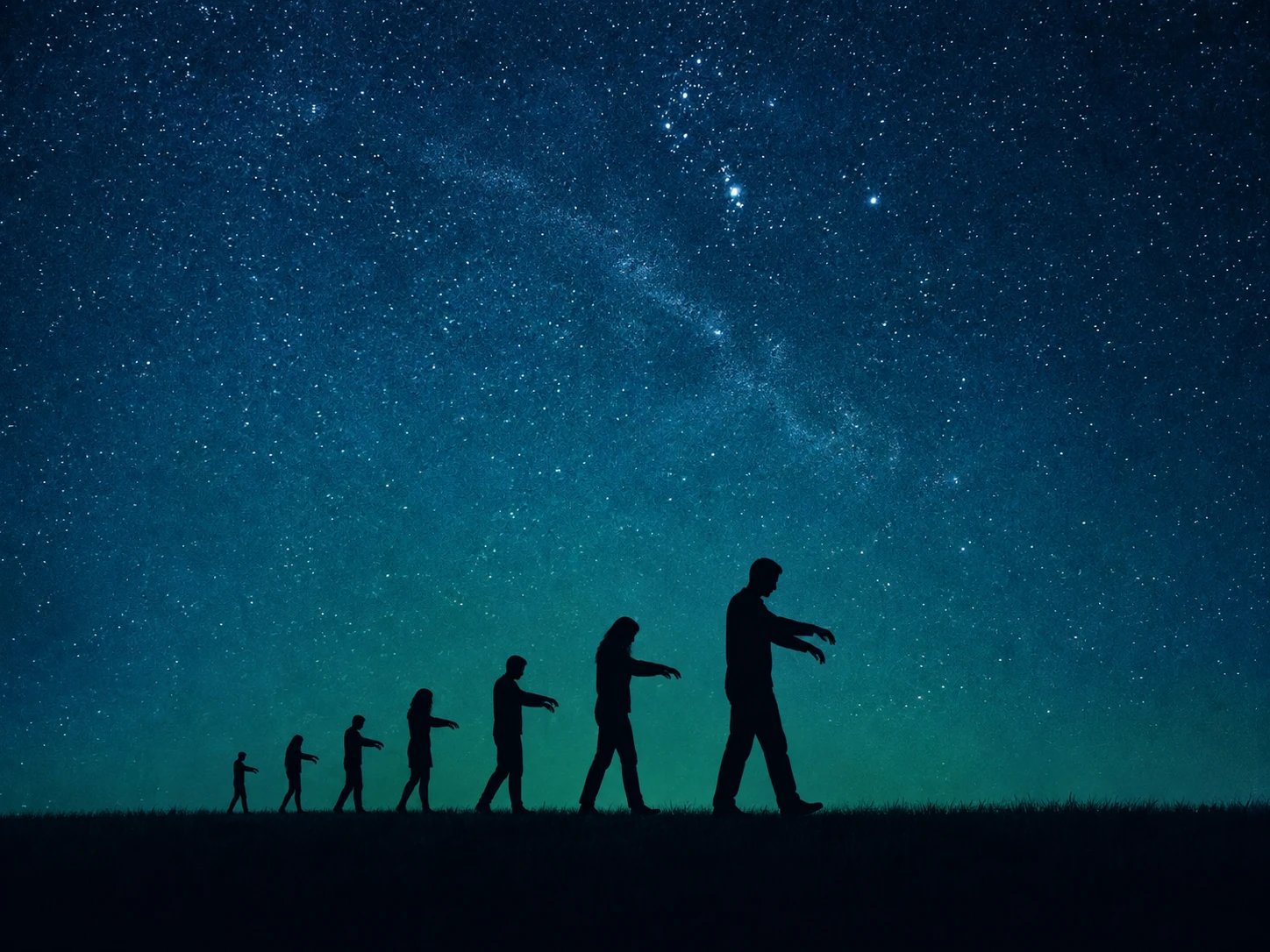
Does it help if my thoughts drift somewhere pleasant?
Not in this study. People drifted to pleasant thoughts more often than to unpleasant ones, yet they were no happier there than when they stayed with what they were doing. When they drifted to something neutral or unpleasant, they were unhappier. And from the timing of the answers, the drifting usually seemed to come first and the low mood after.
Where the mind was mattered more than what the hands were doing.
The last picture
Back to that folder. The first five pictures are dark. App logos and glowing billboards cover the buildings, and in most of them the people are drawn as zombies, phones in hand.
In the sixth, the sun is low between the buildings. The people are just people now. They cross a square with their heads bent over their screens, and in the middle of that square a young plant is coming up through the broken pavement. Most of the people walking past are looking at their phones.
The zombies are the easy part of that series. The plant is the part I keep coming back to.
What does a plant have to do with being awake?
A plant is always entirely where it stands. In that picture it is the only thing growing, and the only thing that is all there. The people around it cross the square with their bodies in one place and their attention in another, on a screen in their hand.
Why not stick with the zombies?
A zombie is a verdict on other people, and nobody sees themselves in one. Look at the plant and the question turns around. Somewhere on that square, something is still growing. What in your own day is still growing, and are you there while it happens?
Seven miles of beans
In 1845 Henry David Thoreau, an American writer, borrowed an axe and built a house with his own hands on the shore of Walden Pond, a lake in the woods at Concord, Massachusetts. He lived there for two years and two months. His book about that time, Walden, came out in 1854. More than 170 years ago, he described the feeling of sleepwalking through your own life.
Why is it that men give so poor an account of their day if they have not been slumbering?
In plain English: if people were not asleep, why can they tell you so little about their day? A few lines later he writes:
To be awake is to be alive. I have never yet met a man who was quite awake.
Just before that, he puts a number on it. Millions are awake enough for physical work, he writes, only one in a million for real thinking, and one in a hundred million for a poetic or divine life.
So my crowd of a hundred was generous.
What did Thoreau actually do all summer?
He grew beans, about two and a half acres of them, in rows that added up to seven miles. He did the hoeing himself, barefoot in the early morning dew, and by later in the day his feet were blistered from the sun. Of his beans he wrote: early and late I have an eye to them.
Travelers rode past his field in their carriages, heading west, to nobody knows where, as he put it. He stayed and kept hoeing.
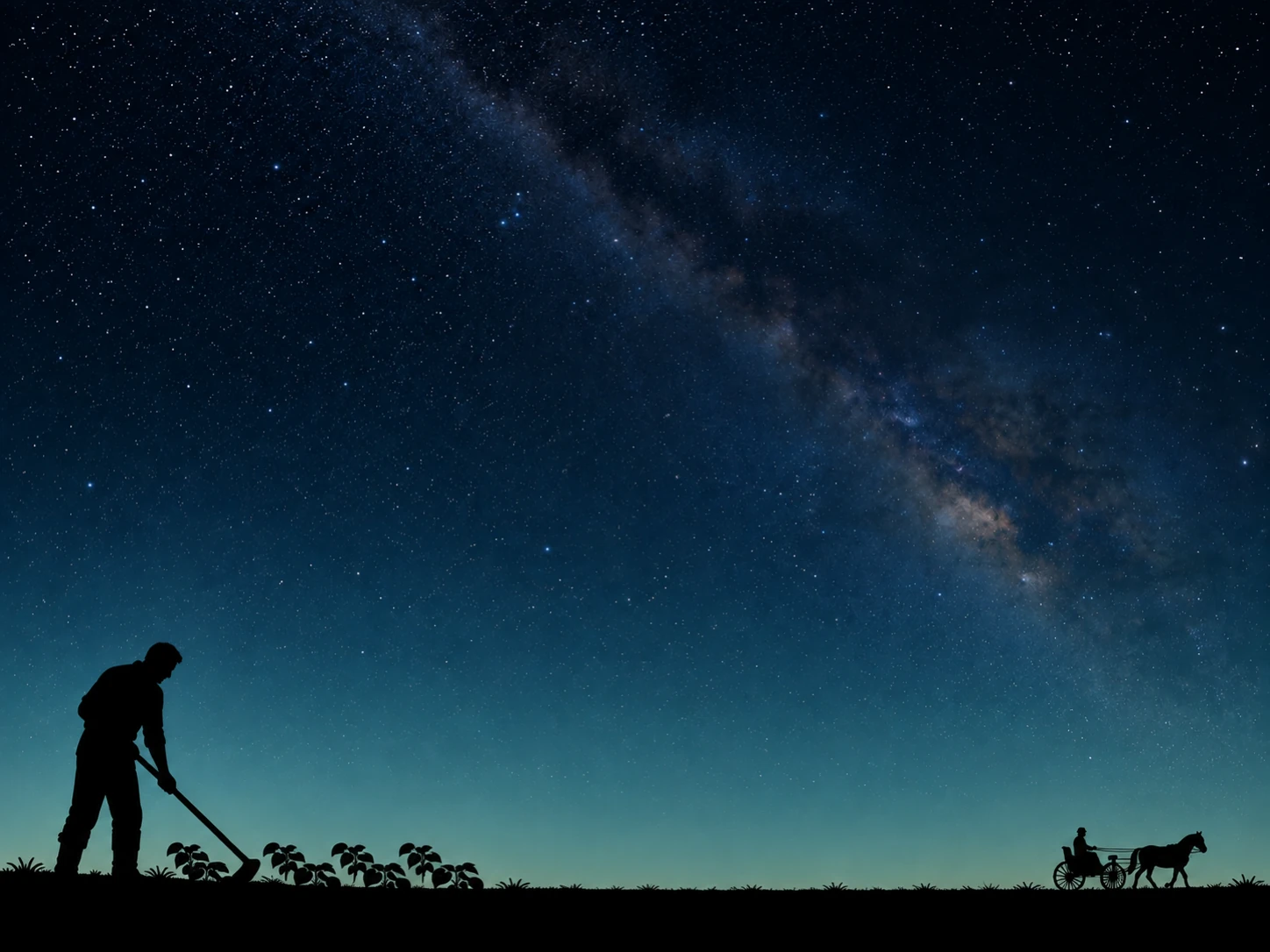
That is what being awake looks like for someone who makes things: one small thing you tend, early and late, with your eyes on it.
Three alarms, ten seconds
How do I stop sleepwalking through my days?
Do what the Harvard researchers did, on yourself. Tomorrow, set three alarms at times you pick without thinking. When one goes off, stop and answer the three questions: how do you feel, what are you doing, and are you thinking about something else? Ten seconds, each time. Last Hour Experience is a cinematic, guided audio experience of about an hour in which you live through your own final hour and then reflect; for this exercise you only need the alarm on your phone.
What if I'm somewhere else almost every time?
Then you know which hours you have been missing. Take one of them and fill it with something that grows as long as you tend it: herbs in a window box, or a tomato plant on the balcony. Thoreau had his beans. You go back to look at something that changes a little each day.
Where the hour fits
In South Korea, in the last days of my career as a pilot, I wrote my own farewell letter and lay in a coffin with the lid closed. On The Deeper Story, a page on this website, there's a video in which I sum up what that did in one line: it wakes you up and sharpens your awareness. It took me years to turn that time in the coffin into an hour you do at home, alone: the Last Hour Experience. If I asked you halfway through that hour whether you were thinking about something else, what would you say?
Questions people ask. One of them is me.
Is my phone the reason I feel like I'm sleepwalking?
Partly, at most. In the Harvard study, minds wandered during nearly everything people did, and the researchers used the phone only to ask their questions. A phone is one more place for your attention to go. You can also use it to check where you are, three times a day.
Is a wandering mind always a bad thing?
No. The same researchers call the ability to think about what isn't happening a remarkable achievement, because it lets people learn, reason and plan. The cost they found is in mood: when people's minds were somewhere else, they were on average less happy than when they were with what they were doing.
Why would growing something help?
Because you keep coming back to one place. Thoreau wrote of his beans that he had an eye to them early and late. Something alive changes a little every day, so you go and look, and while you look, you are where you are. A single pot is enough to begin.
When is this feeling more than a figure of speech?
When it stays. If it goes on for weeks, if you feel cut off from your own body or as if the world around you isn't quite real, or if it comes with a low mood that doesn't lift, talk to your doctor about it. That deserves more than an article.
Sources
A Wandering Mind Is an Unhappy Mind, the 2010 study by Matthew Killingsworth and Daniel Gilbert, psychologists at Harvard University, published in Science, a weekly journal in which scientists publish new research. The 2,250 adults, the three questions, the 46.9 percent, the one activity where minds wandered less than 30 percent of the time and the finding that the drifting usually came before the low mood all come from there.
Walden, the 1854 book by Henry David Thoreau, an American writer, about his two years and two months in a house he built himself at Walden Pond. The lines about being awake are in the second chapter, Where I Lived, and What I Lived For. The beans, the seven miles of rows and the travelers are in the chapter The Bean-Field. The whole book is free to read on Project Gutenberg, an online library of books whose copyright has run out.
The six pictures of people and their phones are from the folder where I collect ideas for these articles. The line about the coffin is from the video on The Deeper Story.